
Durga Puja in Kolkata: The Ultimate Guide to Bengal's Biggest Festival
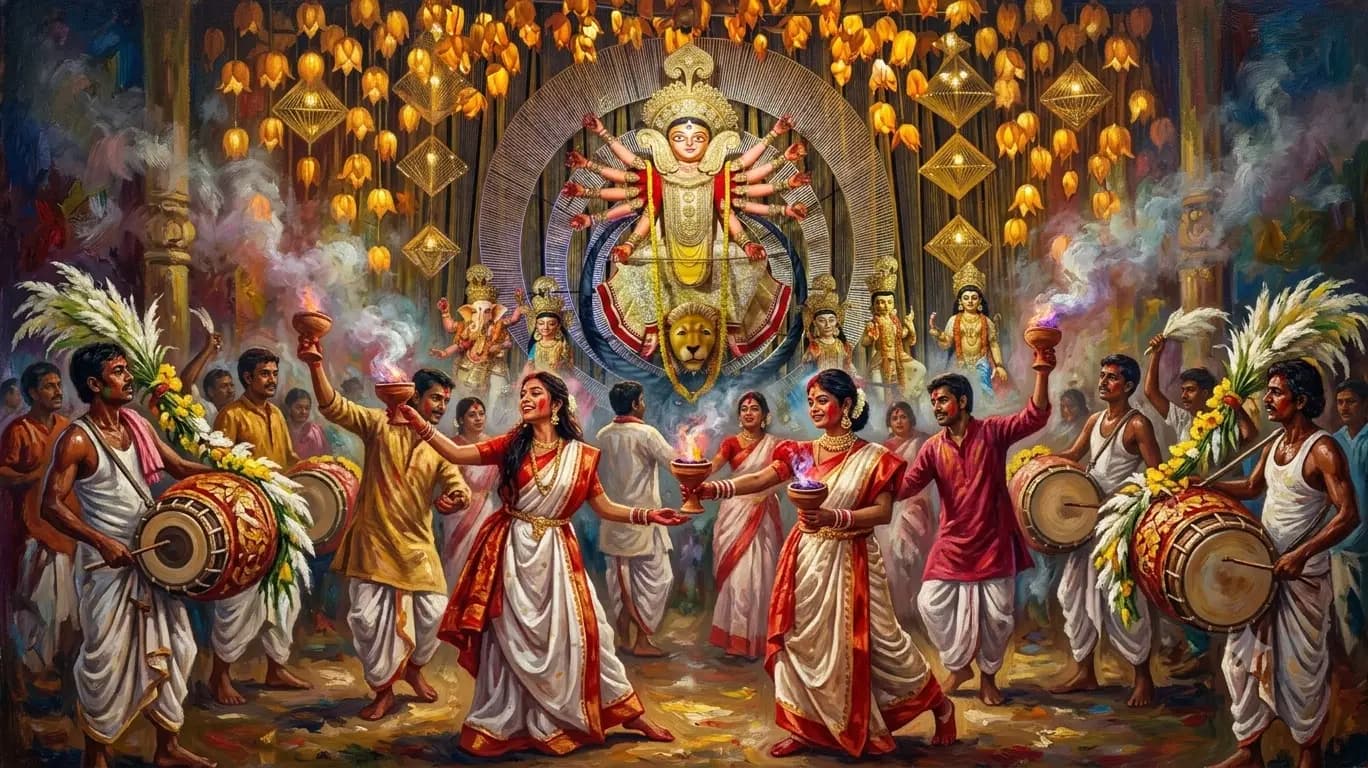
From Mahalaya at dawn to the farewell of Bijoya Dashami, explore how Kolkata celebrates Durga Puja: its history, pandals, food, music and the Bengali words to know.
Once a year, Kolkata stops behaving like an ordinary city. Streets fill with drumbeats, neighbourhood lanes turn into open-air art galleries, and families step out in new clothes to see, eat and meet. This is Durga Puja, or simply Pujo. It honours the goddess Durga, but for millions of Bengalis it is just as much a season of art, music, food and coming home. In this guide, we look at it the way most Kolkatans live it: as the biggest cultural festival of Bengal.
1. What Is Durga Puja?
Durga Puja, also called Durgotsav or Sharodotsav ("the autumn festival"), is celebrated in the Bengali month of Ashvin, which falls in September or October. The whole season lasts about ten days, and the last five are the heart of it. Each community builds a pandal, a temporary structure that houses the idol of Durga with her four children, and people spend the days visiting, feasting and enjoying music and theatre.
In 2021, UNESCO added "Durga Puja in Kolkata" to its list of the Intangible Cultural Heritage of Humanity. UNESCO describes it as the finest example of religion and art performed in public, and notes how class, religion and ethnic divides fade as crowds walk from one installation to the next.
2. Where It Began: A Short Story
The tale
The best-known story says the goddess Durga defeated the buffalo demon Mahishasura, a victory of good over evil. The story is told in the Devi Mahatmya, a text scholars place between 400 and 600 CE.
The Bengali twist
In Bengal, the festival has a warmer, more family feeling. Durga is seen as a daughter who comes home from her husband's house for a few days, bringing her children Lakshmi, Saraswati, Ganesha and Kartikeya. On the tenth day, she returns to Mount Kailash. That is why married daughters traditionally visit their parents during Pujo, and why the festival has become a symbol of homecoming.
The autumn timing also has a story: a 15th-century Bengali retelling of the Ramayana, the Krittivasi Ramayan, has Rama worship Durga before the "wrong" season, which gave the festival one of its names, Akalbodhan ("untimely awakening").
From palace courtyards to street corners
Early celebrations belonged to wealthy families.
- 1610 - The Sabarna Roy Choudhury family begins its puja at Barisha, probably the oldest in Kolkata.
- 1757 - Maharaja Nabakrishna Deb starts the puja at Sovabazar Rajbari, soon after the Battle of Plassey. British officials attended, and it was nicknamed Companir Pujo (the Company's Puja).
- 1910 - The first barowari (community) puja in Kolkata is held in Bhowanipore, funded by neighbours rather than one rich family.
- Today - About 3,000 barowari pujas were held across Kolkata in 2022.
3. Why It Matters: A Festival for Everyone
- Art. Idols are made from clay by artisans in workshops, and the work starts months before the festival. On Mahalaya, the eyes are painted onto the idol, a step called chokkhudaan, which is believed to bring the goddess to life.
- Community. Neighbourhood committees collect donations, hire priests and artists, and build the pandals together. People of many faiths and backgrounds join the crowds, which is why the festival is often described as a melting pot.
- Creativity. Pandals are built around themes: folk culture, cinema, environmental protection, famous monuments, and even recycled scrap.
- Livelihood. A British Council study valued the creative economy around the festival at about ₹32,000 crore for 2019, around 2.6% of West Bengal's economy that year. For idol makers, drummers, lighting crews and sweet shops, Pujo is the biggest earning season of the year.
4. The Days at a Glance
| Day | What happens |
|---|---|
| Mahalaya | The countdown begins. Families remember their ancestors, and the city wakes before dawn to listen to a famous radio programme. |
| Shashthi | The sixth day. The goddess is welcomed with a ritual called Bodhon, and the festivities begin. |
| Saptami | The seventh day. A bundle of nine plants dressed like a bride, called the Kolabou, is bathed and placed beside the goddess. |
| Ashtami | The eighth day. People offer flowers in pushpanjali, and at the moment between Ashtami and Navami, the special Sandhi Puja takes place with 108 lamps. |
| Navami | The ninth day, known for feasting (bhog) and the dance of the incense burners called dhunuchi naach, set to the beat of the dhak drums. |
| Dashami (Bijoya) | The tenth day. Married women smear each other with red sindoor in sindoor khela, and the idols are carried in procession to the river for bishorjon (immersion). |
5. Words, Songs and Stories: The Literary Side
Pujo is also a season of reading and listening. Some traditions here are older than most people's grandparents.
- Mahishasuramardini (the Mahalaya broadcast). Since 1931, All India Radio Calcutta has played this roughly 90-minute programme at daybreak on Mahalaya. It blends Sanskrit chanting, Bengali songs and short dramatic passages, narrated by Birendra Krishna Bhadra with music by Pankaj Mullick. Many Bengalis still wake around 4 am to hear it. When a different voice was tried in 1976, listeners did not warm to it, and the original returned.
- Agomoni songs. Agomoni means "arrival", and these songs welcome the goddess home. Some of the best-loved ones feature in the Mahalaya programme.
- Pujabarshiki (Puja annual issues). Bengali magazines such as Anandamela, Desh, Shuktara and Sananda publish extra-thick festival editions, filled with new stories, poems and comics from famous and upcoming writers.
- Feluda. Satyajit Ray's detective first appeared in the children's magazine Sandesh in 1965. Nearly every Feluda story was first published in a Puja issue of Sandesh or Desh, so for generations the new Feluda novel has been part of the festival. Sonar Kella (The Golden Fortress) is a popular place to start.
- Sukumar Ray and Sandesh. The magazine itself was founded by Satyajit's grandfather. Read more in our article on Sukumar Ray.
6. Durga Puja Around the World
Wherever Bengalis have settled, they bring Pujo with them. UNESCO notes that the festival is celebrated beyond Kolkata, among the Bengali diaspora too.
- Bangladesh and Nepal - Durga Puja is a public holiday, as it is in several Indian states.
- Delhi - The first community puja was held near Kashmere Gate in 1910.
- United States - The oldest community Durga Puja was held at Columbia University in 1970, and today most big cities have one.
- Canada - Toronto has the most puja venues, plus a dedicated Durga temple.
- United Kingdom - In 2006 the Bengali community in London was allowed to immerse its idols in the River Thames.
- Europe - Stockholm has celebrated since 1988, and pujas are held in Germany, Switzerland and the Netherlands.
- Elsewhere - Sydney, Johannesburg, Addis Ababa, Tema in Ghana, Hong Kong, Shanghai and Tokyo all have celebrations.
In many of these cities, the puja runs over a weekend, with cultural evenings of music, dance and drama alongside the rituals.
7. Book Recommendations for Children
Picture books on Durga Puja are still rare, but here are good places to start.
- Abol Tabol by Sukumar Ray - Not a Puja book, but a joyful collection of nonsense poems, ideal for reading aloud and for children learning Bengali sounds.
- The Complete Adventures of Feluda by Satyajit Ray - For older children and teens. The stories are narrated by the teenage Topshe and were first published for Puja issues.
- Image-Makers of Kumortuli and the Durga Puja Festival (Niyogi Books) - A photo-rich book on the idol makers, a good one for parents and older readers.
8. The Mood of Kolkata
Before the festival
The mood builds slowly. Workshops in the old potters' quarter work through the summer, shops fill with festive clothes, and the sky and light feel different in autumn. Pandals in Kolkata open to visitors from Mahalaya, earlier than the official first day, to spread out the huge crowds.
During the five days
Kolkata hardly sleeps. Shops and eateries stay open through the night, streets are packed with people in new clothes, traffic crawls, and lights and loudspeakers fill the evening. It is hard to find anyone indoors. Friends and relatives meet, and the Bengali love of adda (long, relaxed conversation) is at its best.
Dashami
The final day is bittersweet. Women celebrate with sindoor khela, drummers play, and the idols are taken to the Hooghly river. As they go, people call out a wish that means "it will happen again next year" (Asche bochhor abar hobe).
The taste of Pujo
Food is half the festival.
- Bhog - the vegetarian meal offered to the goddess and shared with everyone, often with khichuri.
- Luchi and kosha mangsho - fried flatbread with slow-cooked spicy mutton.
- Phuchka - Kolkata's version of pani puri, a pandal-hopping favourite.
- Mishti - Bengali sweets such as rosogolla, sandesh and mishti doi.
9. Things to Do in Kolkata During Durga Puja
- Wake up for Mahalaya. Listen to the radio programme at dawn, or watch families perform tarpan by the Hooghly ghats.
- Walk through Kumortuli. This North Kolkata potters' quarter is where many of the city's idols are made. Go before Shashthi, when workshops are busiest. The nearest metro station is Sovabazar Sutanuti.
- Visit a heritage puja. Sovabazar Rajbari (1757) and Jorasanko Daw Bari are among the old family pujas, known for traditional idols and rituals.
- Go pandal hopping. North Kolkata is known for older, traditional pujas (Hatibagan, Telenga Bagan), while the south is famous for big themes (Maddox Square, Chetla Agrani, Hindustan Park, Deshapriya Park). Check this year's list before you go.
- Eat at the pandals. Try phuchka, rolls, bhog and sweets from the stalls.
- Catch the carnival. The Durga Puja Carnival on Red Road, begun in 2016, showcases selected idols and tableaux after the festival ends.
- Watch the immersion. On Dashami, join the crowds at the river to say goodbye to the goddess.
Practical tips for pandal hopping
- Wear comfortable shoes and carry little.
- Start early in the day for shorter queues.
- Do not cram too many pandals into one night. Spread your visits across several days; the peak nights are busiest.
- Keep some cash, and use the Metro, which usually extends its hours during the festival (check the latest announcements).
10. Bengali Words for Pujo
| Bengali | Romanised | Meaning |
|---|---|---|
| পুজো | Pujo | festival / worship |
| মা | Ma | mother, also the affectionate name for the goddess |
| ঠাকুর | Thakur | deity or idol. Thakur dekha means going to see the idols |
| ঢাক | Dhak | the large drum of the festival |
| ঢাকি | Dhaki | the drummer |
| নতুন জামা | Notun jama | new clothes |
| আড্ডা | Adda | a relaxed chat with friends |
| ভোগ | Bhog | the sacred meal |
| বিসর্জন | Bishorjon | immersion of the idol |
| শুভ বিজয়া | Shubho Bijoya! | the greeting after Dashami, used with a hug or a touch of the elders' feet (pronounced: Shoo-bho Bi-jo-ya) |
Why It Matters for Learners
Durga Puja is one of the best moments to hear Bengali used in real life, in songs, greetings, street food orders and family chatter. Learn the words above, listen to the Mahalaya songs, and try greeting someone with "Shubho Bijoya" after Dashami. Language and culture grow together, and Pujo is where they meet most beautifully.
Comments
No comments yet. Start the conversation.