
Sukumar Ray: The Writer Who Transformed Bengali Children's Literature
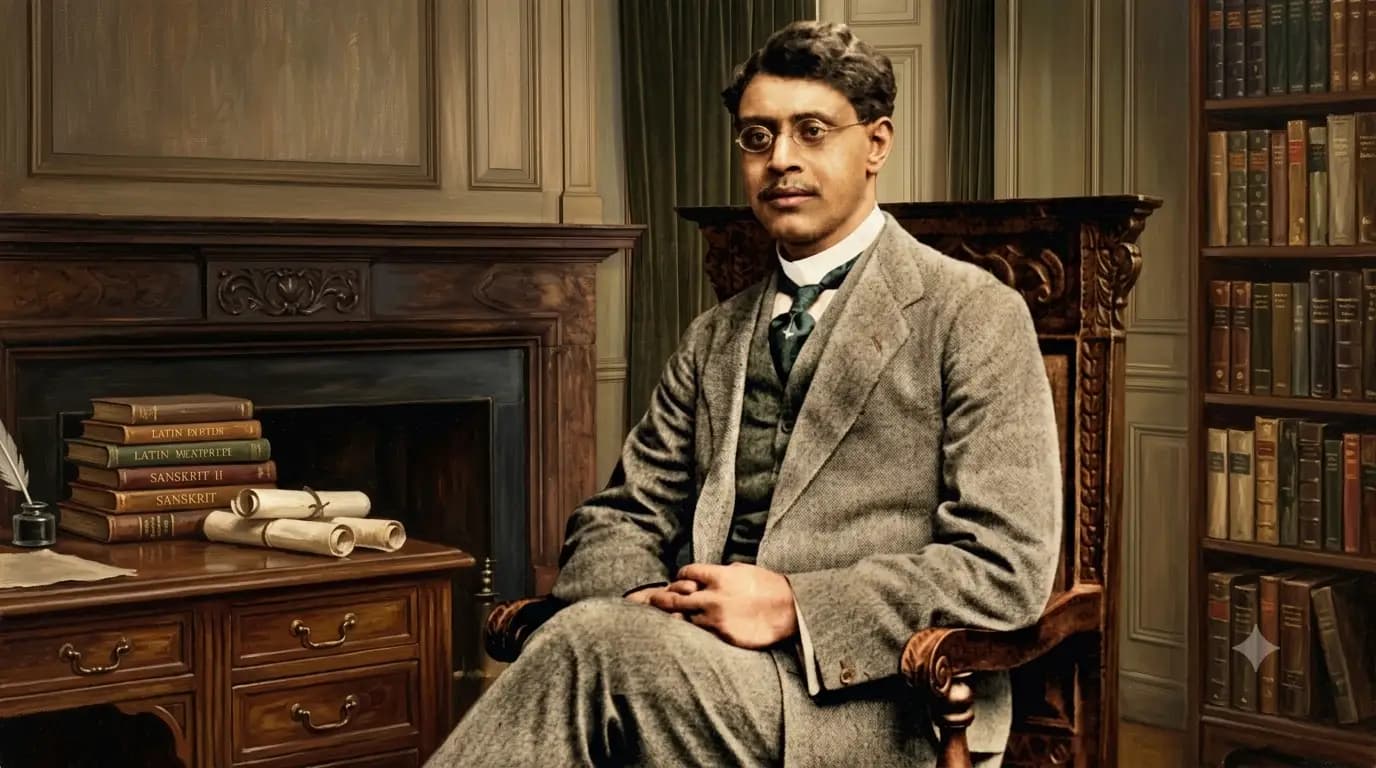
Meet Sukumar Ray, the Bengali Lewis Carroll behind Abol Tabol, the hansjaru and Pagla Dashu, and see why his playful poems are a joyful way to learn the language.
Few writers have made Bengali readers laugh as loudly, or think as sharply, as Sukumar Ray. Born in Calcutta on 30 October 1887 and gone on 10 September 1923, aged only thirty-five, he packed into a short life an astonishing body of nonsense verse, plays, stories and illustrations that Bengalis still recite today. Often compared to Lewis Carroll, he pioneered literary nonsense in Bengali, and his playful way with words makes him a rewarding companion for anyone learning the language.
Ancestors: The Rays of Masua
Family tradition traces the Ray line to Ramsunder Deb, a native of Chakdah in Nadia, who travelled east to Sherpur in search of fortune. The zamindar of Jashodal, Raja Gunichandra, was impressed by his bearing and intellect, made him his son-in-law and granted him land. His descendants later settled in the village of Masua, in present-day Kishoreganj district, Bangladesh.
Sukumar's grandfather, Kalinath Ray, was a scholar of Sanskrit, Arabic and Persian. His father, Upendrakishore, was born Kamadaranjan Ray and was adopted at the age of five by a relative, the zamindar Harikishore, who renamed him. Upendrakishore's elder brother, Saradaranjan Ray, was a pioneer of Indian cricket. Sukumar's mother, Bidhumukhi Devi, was the daughter of the social reformer Dwarkanath Ganguly.
Early Life and Education
Sukumar was born into a Brahmo family at the height of the Bengal Renaissance. His father was a writer, painter, violinist, composer, amateur astronomer and entrepreneur, and the household's friends included Rabindranath Tagore, the scientists Jagadish Chandra Bose and Prafulla Chandra Ray, and the composer Atul Prasad Sen. His sister, Shukhalata Rao, became a social worker and children's author, and his brother Subinoy later helped him run the family business.
He attended City College School, where a classmate is said to have inspired his comic character Pagla Dashu. In 1906 he graduated from Presidency College with double honours in physics and chemistry. He then travelled to England to train in photography and printing technology at the School of Photo-Engraving and Lithography in London, now the London College of Communication. There he developed new halftone blockmaking methods, published technical articles in the Penrose Annual, and lectured on Tagore's songs.
Marriage
Sukumar married Suprabha Devi in 1914, according to genealogical records. A photograph from that year shows the young couple together. Their marriage coincided with the most productive stretch of his writing, the years when Abol Tabol's first poems appeared in Sandesh.
Children and Descendants
The couple had one child, Satyajit Ray, born on 2 May 1921. Sukumar died when his son was about two years old, yet his influence shaped Satyajit's imagination. Satyajit became one of the world's most celebrated filmmakers, directing 36 films, and he honoured his father in 1987, Sukumar's centenary year, with a short documentary built from photographs and paintings. He also wrote the preface to the centenary edition of his father's collected works. Satyajit's son, Sandip Ray, is a filmmaker too, so the family's creative line runs through four generations.
Works: The Art of Delightful Nonsense
Ray's masterpiece is Abol Tabol, a collection of nonsense poems. Satyajit noted that its first poem, "Khichuri", appeared in 1914 and introduced the strange creatures of Sukumar's world, built through clever language play. The hansjaru, a blend of duck and porcupine, is the most famous, and the same trick gives us the bakchhop, singhorin and hatimi. His cast includes Kaath Buro, Tash Goru, Huko Mukho Hangla and Kumro Potash, characters wildly unreal yet oddly familiar.
His prose is just as inventive. The Pagla Dashu stories follow a mischievous schoolboy, while HaJaBaRaLa is a surreal adventure of absurd courtrooms and eccentric characters. His play Chalachittachanchari has been compared to Alice in Wonderland, and Heshoram Hushiyarer Diary is an early science fiction parody. Ray described his writing as the product of kheyal ros, the joy of whim and fancy. Beneath the laughter lies sharp observation, which is why adults enjoy his work as much as children.
Other Significant Events and Activities
Sukumar was also a technologist, illustrator and photographer, and a pioneer of photography and lithography in India. Back in Calcutta, he joined the family firm, U. Ray and Sons, where his father had built a printing press capable of high-quality halftone and colour work. Upendrakishore launched the children's magazine Sandesh in May 1913, and Sukumar's writings and sketches began appearing in it soon after his return from England.
After Upendrakishore died on 20 December 1915, Sukumar ran the press and edited Sandesh for about eight years, supported by Subinoy and relatives who contributed to the magazine. He was also active in the reformist wing of the Brahmo Samaj and wrote a poem recounting its history. At home he convened the "Monday Club", a weekly gathering where friends shared irreverent opinions, and he wrote playful poems to summon members to meetings.
Recognition and Legacy
In 1912 Ray joined the Royal Photographic Society, remaining a member until his death, and in 1922 he gained its Fellowship. His technical work earned him respect in Britain, but his lasting fame comes from literature. More than a century later he remains among the most beloved children's writers in both West Bengal and Bangladesh. His verses are quoted in everyday speech, adapted for stage and screen, and translated into English, notably in Wordygurdyboom! by Sampurna Chatterjee (Penguin India, 2016).
Final Years
In 1923 Ray fell ill with kala-azar (visceral leishmaniasis), for which no cure existed then. He died in Calcutta on 10 September 1923, leaving his wife and young son. His wit and his creatures outlived him, and Abol Tabol remains his best-loved book.
Prominent Books by Sukumar Ray
- Abol Tabol (The Weird and the Absurd) — his celebrated collection of nonsense verse.
- Pagla Dashu (Crazy Dashu) — comic stories about a mischievous schoolboy.
- HaJaBaRaLa (Mumbo-Jumbo) — a surreal nonsense adventure.
- Khai-Khai (Eat-Eat) — one of his comic writings.
- Heshoram Hushiyarer Diary — an early science fiction parody.
- Jhalapala O Onanyo Natok (Cacophony and Other Plays) — a volume of comic plays.
- Chalachittachanchari — a play often compared to Alice in Wonderland.
- Lokkhoner Shoktishel (Lokkhon Shellshocked) — another of his comic works.
- Abak Jalpan (A Strange Drink of Water, 1914) — a short humorous piece.
- Bhasar Atyachar (Torture of Language, 1915) — a playful piece on the abuse of language.
- Barnamalatatva (Theory of the Alphabet) — a work on the alphabet.
- Desh-Bidesher Golpo (Tales from Many Lands) — stories from across the world.
Read Sukumar Ray as You Learn Bengali
Short, rhythmic and endlessly inventive, Sukumar Ray's poems are a joyful way to practise reading aloud once you know the Bengali alphabet. Start with a few lines of Abol Tabol, notice how words are stretched and blended, and let the humour carry you through the sounds of the language.
Comments
No comments yet. Start the conversation.