
Introduction to Bengali Pronouns
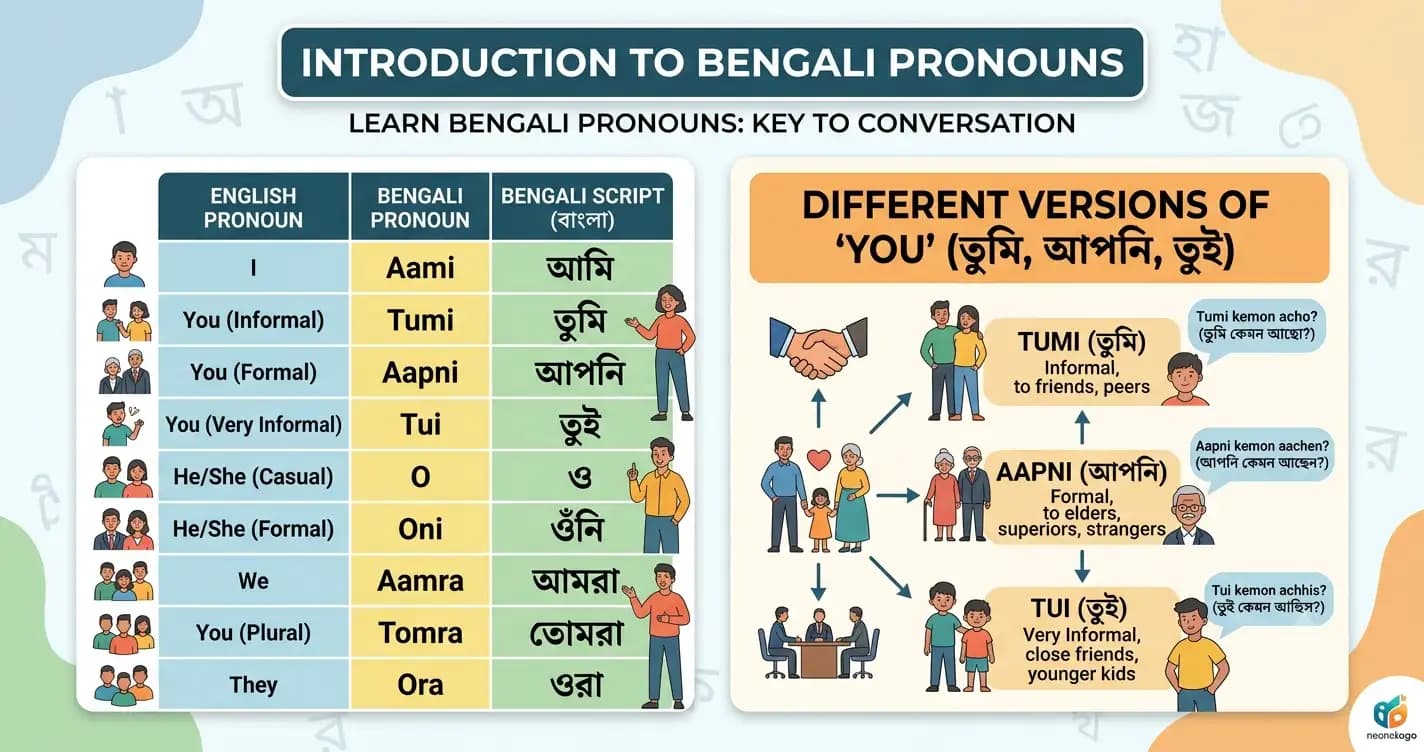
Learn the Bengali equivalents of English pronouns — with a deep dive into the many flavors of "you," from the respect of apni to the intimacy of tui.
Introduction: The Building Blocks of Bengali
If you're just starting out with Bengali, pronouns are one of the first — and most rewarding — building blocks you'll pick up. They work a lot like English pronouns (I, you, he, she, this, that), but Bengali adds something English speakers aren't used to thinking about: levels of respect and familiarity baked right into the word itself.
Below, each pronoun is written as Romanized Bengali first, with the Bengali script in brackets and the English meaning alongside it — for example: Ami (আমি) — "I."
Personal Pronouns: I, We, He/She, They
These are the pronouns you'll use constantly — for yourself, for groups, and for other people.
Ami (আমি) — "I" Ami boi porchhi. (আমি বই পড়ছি।) — "I am reading a book."
Amra (আমরা) — "We" Amra skule jacchi. (আমরা স্কুলে যাচ্ছি।) — "We are going to school."
Se / Tini (সে / তিনি) — "He/She" (informal / formal) Se boi porchhe. (সে বই পড়ছে।) — "He/She is reading a book." (informal) Tini aschen. (তিনি আসছেন।) — "He/She is coming." (formal, used for elders or respected people)
Ora / Tara (ওরা / তাঁরা) — "They" (informal / formal) Ora khela korchhe. (ওরা খেলা করছে।) — "They are playing." (informal) Tara gan gaichchhen. (তাঁরা গান গাইছেন।) — "They are singing." (formal)
Notice something already? Bengali doesn't just have one word for "he/she" or "they" — it splits them by formality. That same idea shows up even more dramatically in the next section.
The Many Faces of "You" in Bengali
Here's where Bengali really diverges from English. In English, "you" is "you" — whether you're talking to your best friend, your boss, or a room full of strangers. Bengali, on the other hand, has three distinct registers for "you" (each with its own plural form), and each one carries its own social meaning. Getting this right (or wrong!) can completely change how a sentence lands — from respectful, to warm and friendly, to intimate and playful — or even accidentally rude.
We'll start with the singular forms, then show you their plural counterparts.
Singular
Apni (আপনি) — "You" (formal/respectful)
Use this with elders, teachers, strangers, or anyone you want to show respect to. When in doubt — especially early in a relationship or with someone older than you — apni is the safer choice.
Apni kothay jacchhen? (আপনি কোথায় যাচ্ছেন?) — "Where are you going?"
Tumi (তুমি) — "You" (informal/friendly)
This is the everyday "you" — used with friends, peers, younger people, or anyone you're on comfortable terms with. It has a warm, familiar tone, similar to "tu" in French.
Tumi kemon achho? (তুমি কেমন আছো?) — "How are you?"
Tui (তুই) — "You" (very informal/intimate)
The most casual register of all — reserved for very close friends, younger siblings, or your own children. It can sound endearing between people who know each other well, but disrespectful or rude if used with the wrong person, so it's best to wait until someone invites you to use it.
Tui ki korchhis? (তুই কী করছিস?) — "What are you doing?"
Plural
Apnara (আপনারা) — "You all" (formal)
The respectful plural form — perfect for addressing a group of elders, colleagues, or people you don't know well.
Apnara ki korben? (আপনারা কী করবেন?) — "What will you all do?"
Tomra (তোমরা) — "You all" (informal/friendly)
The everyday plural, used the same way as tumi but for a group of friends or peers.
Tomra kothay jacchho? (তোমরা কোথায় যাচ্ছো?) — "Where are you all going?"
Tora (তোরা) — "You all" (very informal/intimate)
The plural of tui — used with a group of close friends or siblings. Like tui, it can sound blunt or even condescending if used with the wrong person, so it's best reserved for people you're genuinely close with.
Tora ki korchhis? (তোরা কী করছিস?) — "What are you all doing?"
Why This Matters
Here's the part that trips up a lot of learners: this same apni/tumi/tui split doesn't stop at "you" — it carries through to possessives ("your") and even verb endings. Say apnar (আপনার) to your professor, tomar (তোমার) to a friend, and tor (তোর) to a younger sibling, and you're speaking correctly and appropriately. Mix them up, and even a simple sentence can come across as too casual, too stiff, or even rude. When you're unsure which one to use, a good rule of thumb is: the less you know someone, or the more respect they're owed, the more formal your "you" should be.
Demonstrative Pronouns: This, That, These, Those
Eta (এটা) — "This" Eta amar boi. (এটা আমার বই।) — "This is my book."
Ota (ওটা) — "That" Ota ki? (ওটা কী?) — "What is that?"
Egulo (এগুলো) — "These" Egulo phol. (এগুলো ফল।) — "These are fruits."
Ogulo (ওগুলো) — "Those" Ogulo khelna. (ওগুলো খেলনা।) — "Those are toys."
Possessive Pronouns: My, Your, His/Her, Their
Just like the personal pronouns, possessives shift with formality — especially "your," which mirrors the apni/tumi/tui split you just learned above.
Amar (আমার) — "My/Mine" Eta amar boi. (এটা আমার বই।) — "This is my book."
Apnar / Tomar / Tor (আপনার / তোমার / তোর) — "Your" (formal / informal / very informal) Eta apnar kolom. (এটা আপনার কলম।) — "This is your pen." (formal) Eta tomar boi. (এটা তোমার বই।) — "This is your book." (informal) Tor naam ki? (তোর নাম কী?) — "What is your name?" (very informal, to a close friend or younger sibling)
Or / Onar (ওর / ওনার) — "His/Her" (informal / formal) Eta or boi. (এটা ওর বই।) — "This is his/her book." (informal) Eta onar ghor. (এটা ওনার ঘর।) — "This is his/her house." (formal)
Oder / Onader (ওদের / ওনাদের) — "Their" (informal / formal) Oder kaj shesh hoyechhe. (ওদের কাজ শেষ হয়েছে।) — "Their work is finished." (informal) Onader kaj khub bhalo. (ওনাদের কাজ খুব ভালো।) — "Their work is very good." (formal)
Reflexive Pronouns: Myself, Yourself, Himself/Herself
Nije (নিজে) — "Myself" (and self- in general) Ami nije korbo. (আমি নিজে করবো।) — "I will do it myself."
Tumi nije (তুমি নিজে) — "Yourself" (informal) Tumi nije poro. (তুমি নিজে পড়ো।) — "You read it yourself."
Se nije (সে নিজে) — "Himself/Herself" (informal) Se nije korechhe. (সে নিজে করেছে।) — "He/She did it himself/herself."
Interrogative & Relative Pronouns: Who, What, Which, Whom
Ke (কে) — "Who" Ke aschhe? (কে আসছে?) — "Who is coming?"
Ki (কি) — "What" Tumi ki korchho? (তুমি কী করছো?) — "What are you doing?"
Kon (কোন) — "Which" Tumi konta nibe? (তুমি কোনটা নিবে?) — "Which one will you take?"
Kar (কার) — "Whose" Eta kar boi? (এটা কার বই?) — "Whose book is this?"
Je (যে) — "Who/Which/That" (relative) Je chhele khelchhe, se amar bhai. (যে ছেলে খেলছে, সে আমার ভাই।) — "The boy who is playing is my brother."
Quick Reference Table
| English | Romanized | Bengali | Formality |
|---|---|---|---|
| I | Ami | আমি | — |
| We | Amra | আমরা | — |
| You (sing.) | Apni | আপনি | Formal |
| You (sing.) | Tumi | তুমি | Informal |
| You (sing.) | Tui | তুই | Very informal |
| You (pl.) | Apnara | আপনারা | Formal |
| You (pl.) | Tomra | তোমরা | Informal |
| You (pl.) | Tora | তোরা | Very informal |
| He/She | Se | সে | Informal |
| He/She | Tini | তিনি | Formal |
| They | Ora | ওরা | Informal |
| They | Tara | তাঁরা | Formal |
| This | Eta | এটা | — |
| That | Ota | ওটা | — |
| My/Mine | Amar | আমার | — |
| Your | Apnar | আপনার | Formal |
| Your | Tomar | তোমার | Informal |
| Your | Tor | তোর | Very informal |
| Who | Ke | কে | — |
| What | Ki | কি | — |
Practice Makes Perfect
The best way to lock these in is to use them — try greeting a friend with tumi kemon achho? and an elder with apni kemon achhen? today. Once "you" feels natural in all its forms, the rest of Bengali pronouns will fall into place quickly.
Ready to put these into practice? Head over to your BongGo lessons and try the pronouns exercises to test what you've learned.
Comments
No comments yet. Start the conversation.