
Understanding the Bengali Alphabets
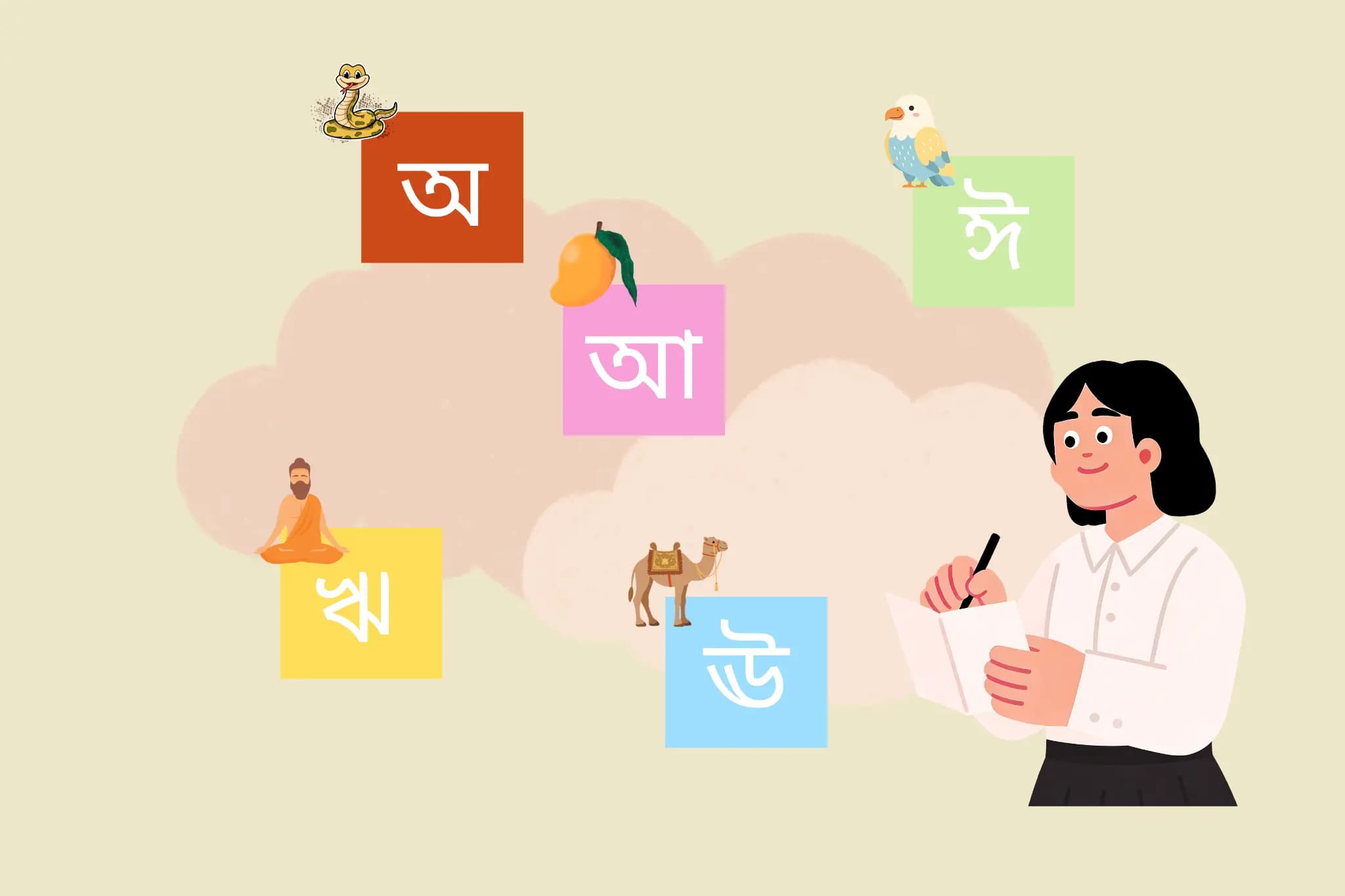
A beginner friendly guide to decoding Bengali letters, from vowels and consonants to matra and vowel marks.
If you are looking at the Bengali script for the first time, you are not just looking at letters. You are looking at centuries of art. The flowing curves and horizontal bars of the Eastern Nagari script can feel like an initial hurdle, but once you understand the logic behind the shapes, the code begins to crack.
The secret to mastering this alphabet is to take small steps. Do not try to memorize all 50+ characters in one sitting. Instead, focus on the building blocks and enjoy the visual journey.
1. The Anatomy of a Character
Unlike the English alphabet, where letters sit independently, Bengali characters often hang from a horizontal line called the matra.
- The Matra: This is the straight line at the top of most letters. When you write a word, this line often connects letters and creates a continuous flow.
- Direction: Just like English, Bengali is written from left to right.
- Abugida System: Every consonant has an inherent vowel sound (usually an o sound) unless you change it with a special mark.
2. The Vowels (Shoroborno): The Soul of the Language
There are 11 vowels in Bengali. These sounds give the language much of its sweetness.
- Independent Form: Use full vowel forms when a vowel starts a word.
- The O Sound (অ): This is the most important base vowel. For English speakers, it is often closer to the o in hot than to an open ah.
- The Ah Sound (আ): A wide-open sound, similar to the a in father.
- Study Tip: Learn the first five vowels first. Once you can recognize them in words and sentences, move to the next set.
3. The Consonants (Byanjonborno): The Skeleton
There are 39 consonants in Bengali, and they are arranged logically by tongue position (the varga system).
- Velars (Back of the throat): K, Kh, G, Gh.
- Dentals (Tongue on teeth): T, Th, D, Dh.
- Aspiration Rule: Many consonants come in pairs, one soft and one with a puff of air.
- Motivation Note: Do not get overwhelmed by the full list. Focus on the most common 15-20 consonants first.
4. Vowel Marks (Kar): The Wrap-Around Magic
This is where Bengali gets visually interesting. When a vowel follows a consonant, it often changes into a shorthand mark that attaches to the consonant.
- Positioning: Kar marks can appear above, below, left, or right of the consonant.
- Example: The vowel ই turns into the mark ি, which is written to the left of a consonant even though it is pronounced after it.
5. Strategy for Absolute Beginners
To build a strong foundation without burnout, use this practical method:
- Muscle Memory: Write letters by hand in a notebook. Physical writing helps your brain map curves faster than typing.
- Do Not Translate Shapes: Avoid guessing letters by visual similarity to English symbols. Associate each shape directly with its Bengali sound.
- Build Simple Words Early: As soon as you know a few letters, find real words using them. Seeing script in context improves recall.
- Think in Sound, Not Translation: If you see ব, do not think the English letter B first. Think of the Bengali sound directly.
Learning Bengali script is not a race. Small, consistent practice sessions will help you decode the alphabet with confidence.
Comments
No comments yet. Start the conversation.